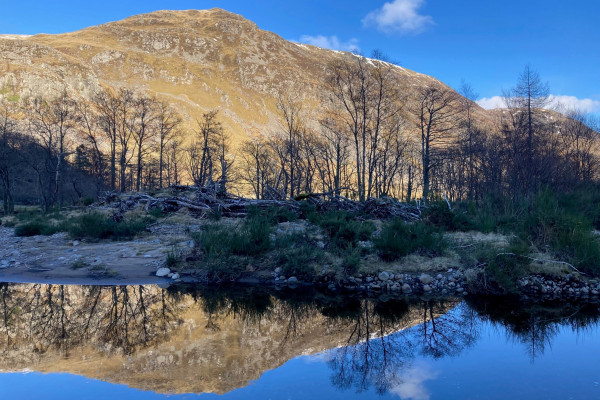
Angus straddles the Highland Boundary Fault Line, a geologic fault line that travels through Scotland from Stonehaven in the east, to Arran in the west. It separates two distinctly different regions – the Highlands and the Lowlands.
Within Angus, east of the fault line, lies the broad valley of Strathmore. The geology in Strathmore dates from the Lower Devonian age and consists mainly of conglomerates and soft sandstones, which were deposited by glaciers and rivers. These sandstone and conglomerates are highly permeable and give rise to Strathmore having some of the most fertile land in Scotland.
To the north west of the fault line lie the harder rocks of the Dalradian age, which support less fertile soil. These upland or highland areas are often covered by heather moorland.
Of particular geological interest, is Corrie Fee, a glacial corrie, which sits at the head of Glen Clova. The corrie was created by a number of glaciations, the last of which occurred 12,000 years ago. Distinctive moraine ridges, or flutes, were carved into the sediment by pressurised, flowing water beneath the glacier. Following the retreat of the last glacier, lochans formed in the corrie, between moraine mounds. Over time, these lochans in-filled with sediment, allowing peat to form. Analysis of this peat has shown that tree species such as Birch species, Hazel, Willow species, and Oak once grew here. Alpine plants are still found growing in Corrie Fee, clinging on to inaccessible rocky edges and gullies.