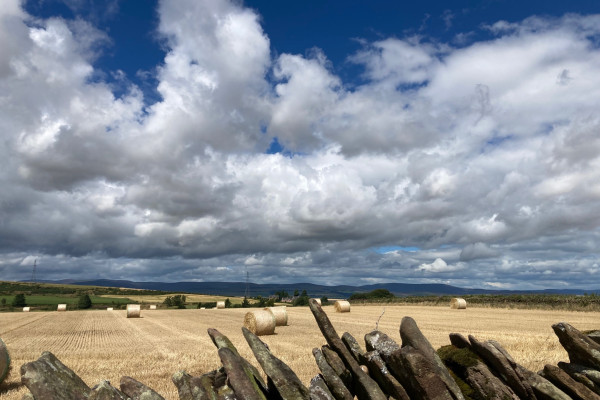
The main land use in the River South Esk catchment and the wider region of Angus, is agriculture.
Angus has 40% of Scotland's grade A land, producing 30% of Scotland’s potatoes (seed and ware) and 25% of the UK’s soft fruit. The fertile soils of the mid and lower catchment together with the mild climate, are ideal conditions for growing top-quality soft fruit, vegetables, grain and potatoes.
In the less fertile, upland areas of the catchment, including the improved grassland on the Glen Clova floodplain, sheep and cattle farming dominates.
Other important land uses in the area are forestry, fishing and field sports.
Forestry is another important land use in the catchment. Commercial plantations are found in Glens Clova and Prosen, whilst pockets of semi-natural woodland are scattered across the catchment. Forestry and Land Scotland’s Monotreatment Forest is the largest conifer plantation in the catchment and is unique in its lower catchment setting. Collectively forest and woodland cover in Angus is ~10.7%, which is lower than the average for Scotland, which is ~ 18%.
The River South Esk is one of the best sea trout rivers in Scotland whilst the River North Esk is one of the most abundant salmon rivers in the northern hemisphere.
Grouse shooting and deer stalking are confined to the heather moorland of the upper catchment, with pheasant and partridge shooting taking place in flood plains of Glen Clova and in the mid-catchment. Wildfowling takes place in a designated 'wildfowling area' on the west side of Montrose Basin in the lower catchment.